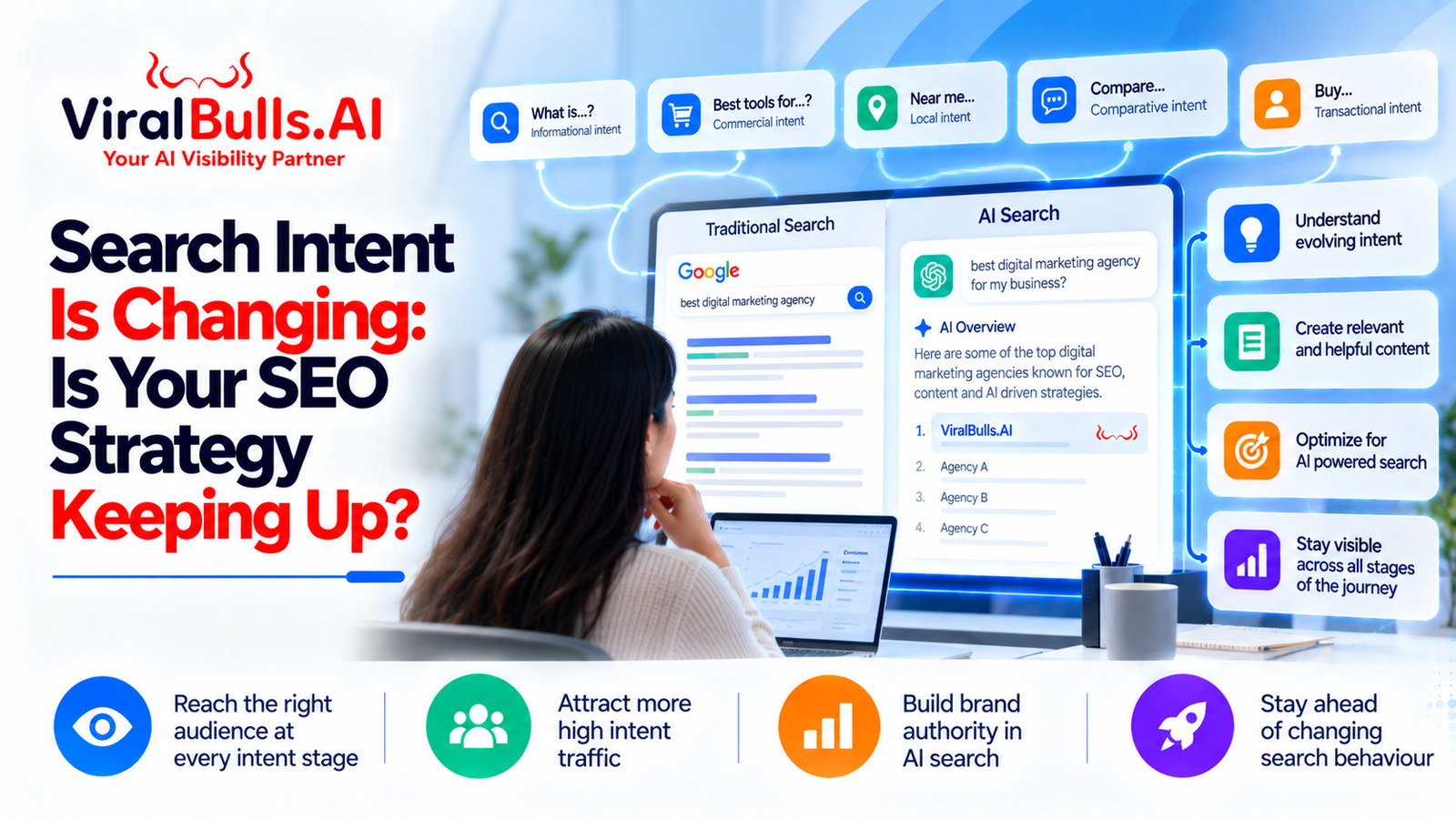
How AI search, zero-click results, and evolving user behavior are rewriting the rules of ranking — and what to do about it.
Type a question into Google today, and there’s a good chance you never click a single blue link. An AI Overview answers it right there. Ask the same question in ChatGPT, Perplexity, or Gemini, and you get a synthesized answer pulled from dozens of sources — with no guarantee your website is even one of them.
If that scenario makes you a little uneasy, it should. For nearly two decades, SEO has run on a simple premise: understand what people are searching for, create content that matches it, and rank. But the “searching” part of that equation is transforming faster than most strategies can keep pace with. Search intent — the actual reason behind a query — hasn’t disappeared. It has evolved, splintered, and become far more conversational, contextual, and immediate. The brands that recognize this shift early are the ones that will still be visible in three years. The rest risk becoming invisible, even while producing more content than ever.
Let’s unpack what’s really changing, why it matters, and how to future-proof your SEO strategy before the gap becomes too wide to close.
Why Search Intent Looks Completely Different Today
Search intent used to fall neatly into four buckets: informational, navigational, transactional, and commercial investigation. That framework still holds some value, but it no longer captures how people actually behave online.
1. Queries Are Longer, More Natural, and More Specific
Voice search, AI chat interfaces, and smarter algorithms have trained users to type — and speak — the way they actually think. Instead of “best running shoes,” searchers now ask, “what running shoes are best for flat feet and marathon training on a budget.” This shift toward long-tail, conversational queries means keyword-stuffed, generic content simply doesn’t match intent anymore.
2. One Query, Multiple Intents
A single search can carry layered meaning. Someone searching “CRM software” might be comparing tools, looking for pricing, or just trying to understand what a CRM even does. Google’s algorithms are increasingly good at detecting this nuance and rewarding pages that address the full spectrum of intent rather than just one narrow angle.
3. Zero-Click and AI-Generated Answers Are the New Default
AI Overviews, featured snippets, and chatbot summaries are answering questions before users ever reach a website. Industry data has consistently shown organic click-through rates dropping for queries where an AI-generated answer appears above the fold. Visibility now matters as much as ranking — being cited or referenced inside an AI answer can carry more value than a page-one position that nobody scrolls to.
4. Intent Is Increasingly Personalized and Contextual
Location, browsing history, device type, and even time of day now shape what a search engine considers the “right” answer for a given person. Two users typing the identical query can see meaningfully different results. Generic, one-size-fits-all content is losing ground to experiences that adapt to context.
What This Means for Your SEO Strategy
If your current strategy still revolves around targeting a keyword, writing a thousand words around it, and hoping for a top-ten ranking, it’s already behind. Here’s what forward-thinking teams are doing instead.
Shift From Keywords to Topics and Entities
Search engines now understand concepts, not just strings of text. Building topic clusters — a comprehensive pillar page supported by interlinked subtopics — signals depth and authority far more effectively than isolated, keyword-targeted posts ever could.
Optimize for Answers, Not Just Rankings
Since AI Overviews and snippets pull directly from well-structured content, clear headings, concise definitions, comparison tables, and scannable formatting all increase your odds of being the source an AI engine chooses to cite.
Prioritize E-E-A-T Signals
Experience, Expertise, Authoritativeness, and Trustworthiness aren’t buzzwords anymore — they’re ranking factors search engines actively evaluate. Original data, real author bios, first-hand case studies, and credible citations all help content stand out in a landscape flooded with AI-generated sameness.
Map Content to the Full Funnel
Because intent is layered, your content library should address awareness, consideration, and decision stages for the same core topics — not just chase high-volume, top-of-funnel keywords. This funnel approach keeps you visible at every point in a longer, more fragmented buyer journey.
Treat Generative Engine Optimization (GEO) as Part of SEO, Not a Side Project
Optimizing to be referenced inside AI-generated answers now sits alongside traditional ranking work. That means structured data, clear factual statements, and authoritative sourcing carry double duty — helping both classic search engines and AI models understand and trust your content.
A Practical Path Forward
Adapting doesn’t mean abandoning everything you know about SEO. It means layering new practices on top of a solid foundation. A practical starting point looks like this:
- Audit your top-performing pages to see which ones are losing clicks despite steady rankings — this often signals AI Overview cannibalization.
- Reorganize existing content into topic clusters instead of isolated, disconnected posts.
- Add clear, quotable definitions and summaries near the top of key pages so they’re easier for AI systems to extract and cite.
- Strengthen author credibility with real bios, credentials, and original insights or data.
- Track new metrics beyond rankings — impressions, brand mentions in AI answers, and assisted conversions matter more than ever.
None of this happens overnight, and that’s exactly the point. Search behavior will keep evolving, and the strategy that wins isn’t a one-time fix — it’s a mindset of continuous adaptation.
The Bottom Line
Search intent isn’t just changing — it’s becoming more human. People want faster answers, more relevant context, and content that respects their time. SEO strategies that still treat search as a static, keyword-matching exercise will quietly lose ground, even if the metrics look fine today.
The opportunity here is real: brands that lean into topic authority, answer-first content, and genuine expertise are earning outsized visibility precisely because so many competitors haven’t caught up yet. You don’t need to have all the answers today. You need a strategy flexible enough to keep asking the right questions as intent keeps shifting — and the confidence to act on what you learn.
Your audience is already searching differently. The only question left is whether your content is ready to meet them there.
Frequently Asked Questions
What exactly is “search intent,” and why is it suddenly such a big deal?
Search intent is the underlying goal behind a query — whether someone wants information, wants to compare options, or is ready to buy. It’s a big deal right now because AI-powered search and changing user behavior mean intent is more layered and conversational than the simple categories SEO has relied on for years.
Is traditional keyword research still worth doing?
Yes, but it’s no longer sufficient on its own. Keyword data is still useful for understanding demand and language patterns, but it needs to be paired with topic mapping, entity research, and an understanding of how AI tools summarize and cite content.
How do AI Overviews and chatbots affect my organic traffic?
For many informational queries, AI-generated answers can reduce click-through rates because users get their answer without visiting a website. The response isn’t to abandon SEO, but to create content authoritative and well-structured enough to be the source those AI answers pull from and credit.
What’s the fastest way to start adapting my strategy?
Start with an audit. Identify pages losing clicks despite maintaining rankings, then restructure your strongest content into clear, well-organized topic clusters with concise, quotable answers near the top of the page. Small structural changes often produce visible results faster than a full content overhaul.
Does this mean I should write shorter content?
Not necessarily. Length should match the intent and complexity of the topic. What matters more is that the content is well-organized, answers questions clearly and early, and goes deep enough to demonstrate genuine expertise — whether that takes 600 words or 3,000.
How often should I revisit my SEO strategy going forward?
Given how quickly search behavior and AI capabilities are evolving, a quarterly review is a reasonable baseline. Treat SEO as an ongoing practice of measurement and adjustment rather than a strategy you set once and revisit only when traffic drops.