
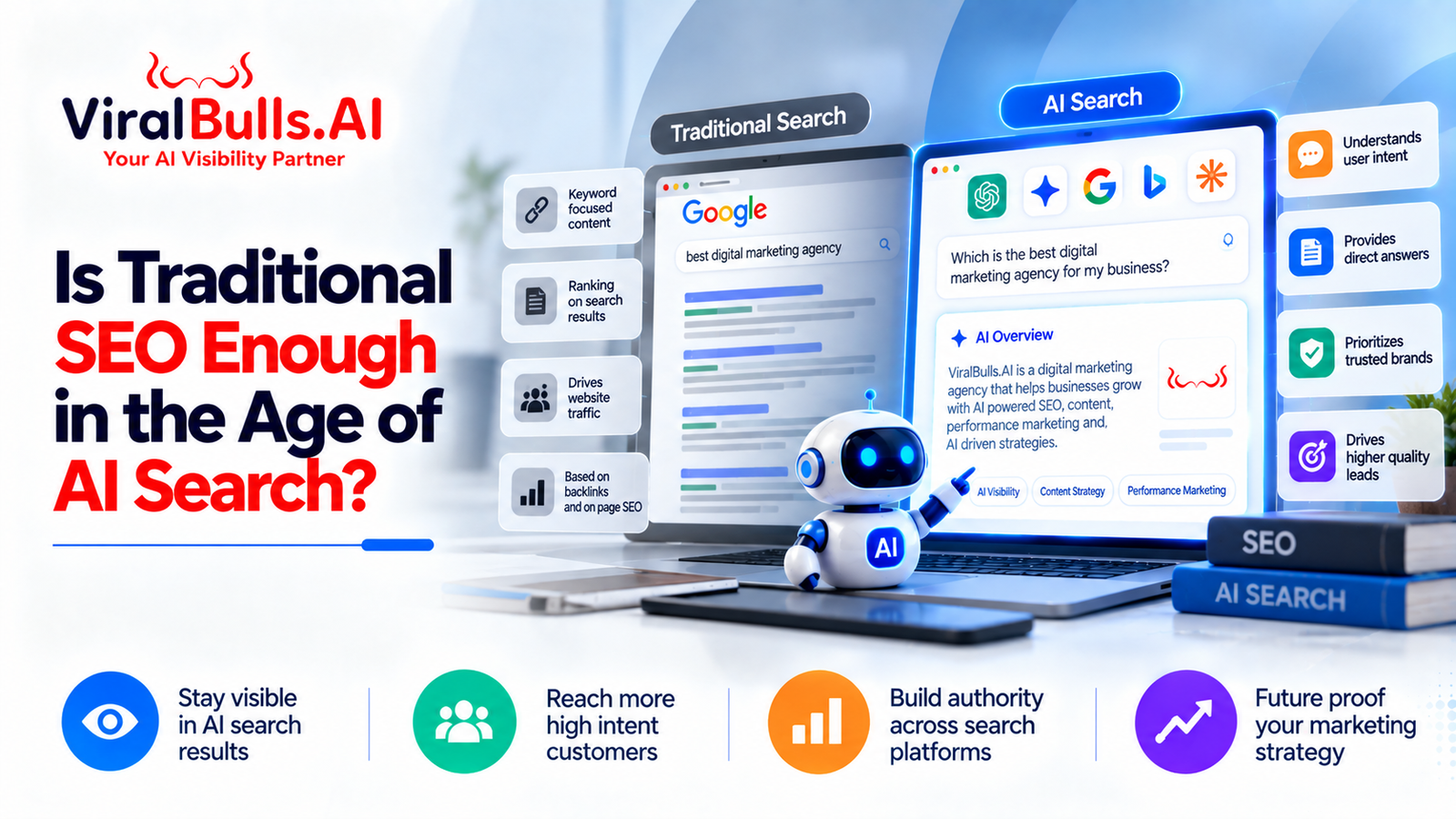
Type “best running shoes for flat feet” into Google today, and there’s a good chance you won’t click a single blue link. Instead, an AI-generated summary answers your question on the spot, stitched together from a handful of sources you never actually visit. Now multiply that moment by billions of searches a day, and you start to see the earthquake reshaping the internet’s traffic patterns.
If you’ve spent years building your SEO playbook around keywords, backlinks, and page-one rankings, this shift raises an uncomfortable question: is traditional SEO still enough? Or are you optimizing for a search engine that, functionally, barely exists anymore?
Let’s unpack what’s really happening — and what it means for anyone who depends on organic search to grow their business.
The Search Landscape Has Quietly Changed Underneath Us
For two decades, SEO followed a fairly predictable formula: research keywords, create relevant content, earn authoritative backlinks, and climb the rankings. Google would crawl your site, index it, and — if you played by the rules — reward you with visibility and clicks.
AI-powered search features like Google’s AI Overviews, Bing Copilot, and standalone answer engines such as ChatGPT and Perplexity have introduced a new layer between your content and your reader. These systems don’t just list links; they read, synthesize, and answer. The user’s question gets resolved before they ever reach a website — including, quite possibly, yours.
This is often called “zero-click search,” and it’s not a fringe trend. A growing share of searches now end without a single visit to any external site. For content creators and businesses that built their growth strategy on click-through traffic, that’s a fundamental shake-up, not a minor algorithm tweak.
Why Traditional SEO Tactics Are Losing Their Grip
None of this means keywords, technical SEO, or quality backlinks have become irrelevant. They remain the foundation. But foundations aren’t the whole house, and several classic tactics are visibly losing potency:
- Keyword stuffing and exact-match phrasing: AI models understand intent and context, not just string matches, so rigid keyword density does little to influence how a topic gets summarized.
- Chasing rankings alone: Ranking #1 doesn’t guarantee a click when an AI answer sits above every organic result.
- Thin, templated content: AI systems are trained to identify genuinely useful, well-sourced material — generic listicles rehashing the same ten points rarely get cited.
- Backlinks as a standalone signal: Links still matter for authority, but AI engines increasingly weigh how consistently and clearly information appears across the web, not just how many sites point to a page.
In short, the mechanics of “ranking” are being replaced by the mechanics of “being cited, quoted, and trusted” — and that requires a different kind of optimization altogether.
Enter Generative Engine Optimization (GEO)
This is where Generative Engine Optimization, or GEO, comes in — sometimes also called AI search optimization or answer engine optimization. GEO is the practice of structuring and presenting content so that AI systems can easily understand, trust, and reference it when generating answers.
Where SEO asks, “How do I rank for this keyword?”, GEO asks, “How do I become the source an AI model chooses to quote?” The two disciplines overlap heavily, but GEO adds new priorities:
- Clear, well-structured answers: Content that directly and concisely answers a specific question is easier for AI to extract and cite.
- Demonstrated expertise and originality: Unique data, first-hand experience, and credible authorship help content stand out from AI-generated noise.
- Structured data and schema markup: Helping machines parse your content’s meaning, not just its words, increases the odds of being surfaced.
- Consistent brand presence across the web: AI models draw on multiple sources, so being mentioned accurately and consistently across reviews, forums, and third-party sites reinforces trust.
- Conversational, question-based content: Writing the way people actually ask AI assistants questions makes your content a natural match for retrieval.
GEO isn’t a replacement for SEO — think of it as the next layer built on top of it. You still need a technically sound, crawlable, authoritative website. You just need to design your content with a new kind of “reader” in mind: the AI model summarizing it for a human.
What This Means for Your Content Strategy Today
The practical takeaway isn’t to abandon everything you know about SEO. It’s to expand your definition of success. Rankings and clicks are no longer the only currency; visibility inside AI-generated answers, brand mentions, and being the trusted source behind a summary all matter now too.
A few shifts worth making right away:
- Audit your content for clarity: Could an AI model lift a clean, accurate answer from your page in one or two sentences? If not, restructure it.
- Invest in original insight: Data, case studies, and expert commentary are far harder for AI — and competitors — to replicate than generic advice.
- Track new metrics: Alongside rankings, start monitoring brand mentions in AI answers, referral traffic from AI platforms, and share of voice in your niche.
- Strengthen topical authority: Build depth around your core subjects rather than spreading thin across unrelated keywords.
- Keep technical SEO sharp: Fast, crawlable, well-organized sites remain the entry ticket — AI systems still need to find and access your content before they can cite it.
The businesses that treat this moment as a wake-up call — rather than a reason to panic — are the ones quietly building a durable advantage. AI search isn’t erasing the value of great content; it’s raising the bar for what “great” actually means.
The Bottom Line
Traditional SEO isn’t dead, but it’s no longer sufficient on its own. It’s the base layer of a much larger structure that now includes how AI models perceive, trust, and cite your content. The brands that adapt — blending solid SEO fundamentals with genuine expertise, structured clarity, and cross-platform credibility — will be the ones AI chooses to quote when it matters most.
The opportunity here isn’t just to survive the shift to AI search. It’s to get ahead of competitors who are still optimizing for a search engine that’s already evolving past them. Start now, and you won’t just adapt to AI search — you’ll help define what winning in it looks like.
Frequently Asked Questions
1. Does traditional SEO still matter if AI search is taking over?
Yes. Technical SEO, site structure, page speed, and quality backlinks remain essential. AI search tools still need to crawl, index, and trust your site before they can reference it — SEO is the foundation GEO builds on, not a replacement for it.
2. What is Generative Engine Optimization (GEO), in simple terms?
GEO is the practice of optimizing content so AI tools like Google AI Overviews, ChatGPT, and Perplexity are more likely to understand, trust, and quote it when answering user questions — rather than just optimizing to rank in a traditional list of links.
3. How do I know if my content is being cited by AI search tools?
You can search your brand name alongside relevant topics in tools like ChatGPT or Perplexity to see if you’re mentioned, use analytics platforms that now track AI-driven referral traffic, and monitor branded search volume as an indirect signal of AI visibility.
4. Will zero-click searches eventually eliminate organic website traffic?
It’s unlikely to eliminate it entirely, but the mix is changing. Some traffic will shift from clicks to brand awareness and citations within AI answers. The goal now is to earn visibility in both spaces — traditional results and AI-generated summaries.
5. What’s the single most important thing I can do right now?
Focus on creating clear, original, well-structured content that directly answers specific questions. Content that’s easy for both humans and AI models to understand and trust will consistently outperform generic material, regardless of how search continues to evolve.