
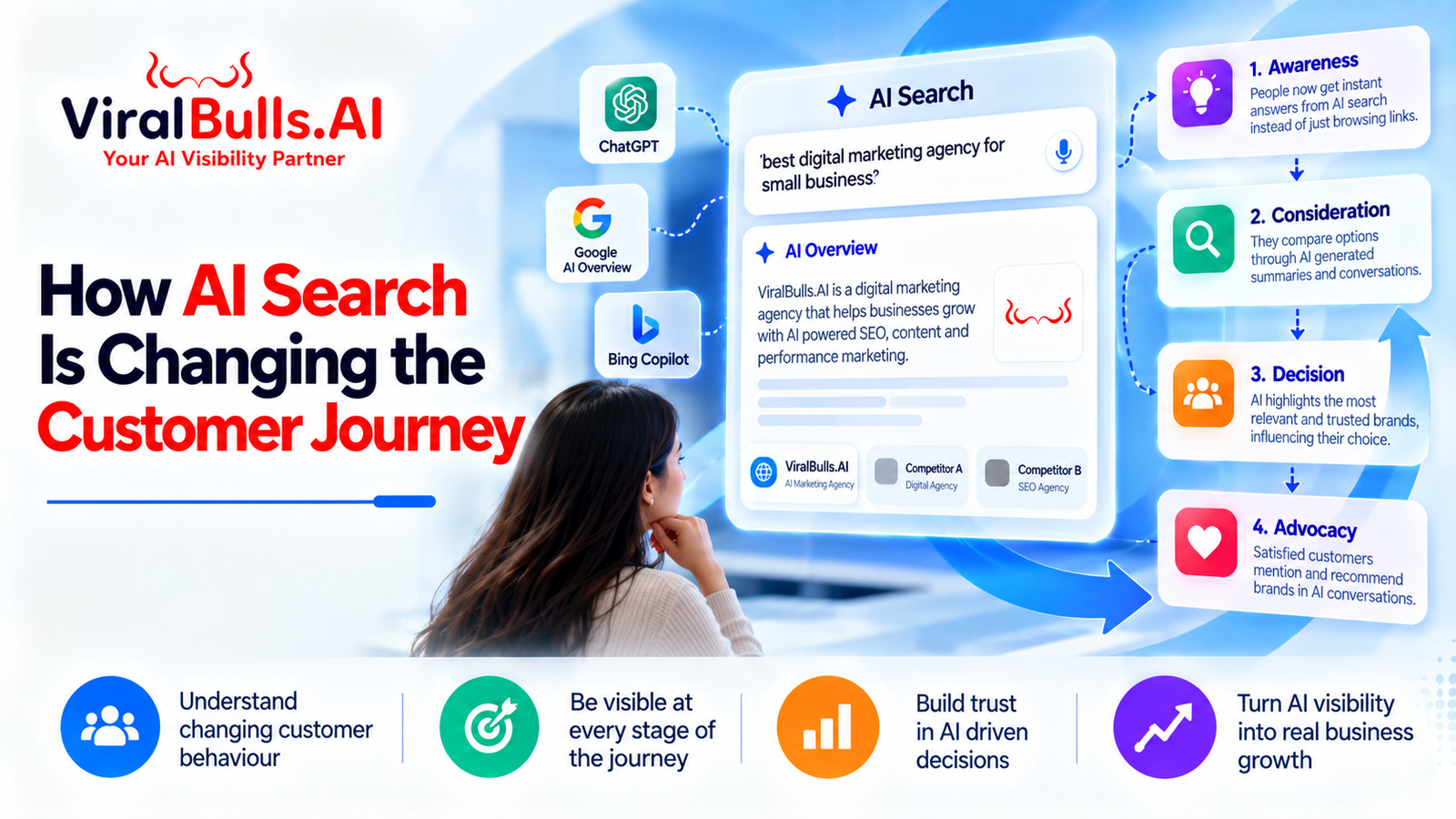
Picture this: a potential customer doesn’t type “best CRM software” into a search bar anymore. Instead, they ask an AI assistant, “What’s the easiest CRM for a 10-person marketing team that integrates with WhatsApp?” In seconds, they get a synthesized answer, a shortlist of tools, and a reason to trust one brand over another — without ever clicking through ten blue links. If that scenario feels unfamiliar, it shouldn’t for long. It’s already happening, and it’s rewriting the rules of how brands earn attention, trust, and conversions.
Welcome to the age of AI search — where tools like ChatGPT, Google’s AI Overviews, Perplexity, and Bing Copilot don’t just index the web; they interpret it, summarize it, and hand your customers an answer before they ever land on your website. For marketers and business owners, this isn’t a minor algorithm update — it’s a fundamental shift in the customer journey, and understanding it is the difference between staying visible and quietly disappearing from the conversation.
In this guide, we’ll walk through how AI search is reshaping each stage of the funnel — from the first flicker of awareness to the final purchase decision — and what you can do today to make sure your brand shows up when it matters most.
The Old Funnel vs. the New Reality
For two decades, the customer journey followed a familiar shape: awareness through search results and social media, consideration through website visits and comparison shopping, and decision through reviews, pricing pages, and checkout. Marketers optimized every stage around one core behavior — typing keywords into a search box and clicking through a list of links.
AI search collapses that behavior. Instead of ten links, the customer gets one conversational answer that has already done the comparing, summarizing, and filtering for them. The funnel hasn’t disappeared, but it has compressed — a lot of the decision-making now happens inside the AI tool itself, before a customer ever reaches your site.
Stage 1: Awareness — Getting Noticed by the Algorithm’s Algorithm
At the top of the funnel, customers used to discover brands through search rankings, social feeds, or word of mouth. Now, they increasingly discover brands through AI-generated summaries that pull from multiple sources to answer broad questions like “what are the best skincare routines for oily skin” or “how do I choose a digital marketing agency.”
Visibility no longer depends solely on ranking #1 on a search results page. It depends on whether AI models consider your content authoritative, well-structured, and citation-worthy enough to reference. This emerging discipline — Generative Engine Optimization (GEO) — sits alongside traditional SEO as a new pillar of digital visibility.
What this means for your brand
- Content needs clear, well-organized answers to specific questions — not just keyword-stuffed paragraphs.
- Structured data, FAQs, and concise definitions help AI tools extract and cite your content accurately.
- Brand mentions across trusted third-party sites (reviews, forums, industry publications) now carry more weight, since AI models often triangulate credibility from multiple sources.
Stage 2: Consideration — Winning Trust Before the Click
Once a customer moves into research mode, AI search tools often present a synthesized comparison: pros and cons, pricing ranges, and even sentiment drawn from reviews. This is where the middle of the funnel gets compressed dramatically. A customer comparing salon booking software, for example, might get a complete side-by-side breakdown from an AI assistant without visiting a single vendor website.
The implication is significant: your brand’s reputation, reviews, and third-party mentions are doing consideration-stage selling on your behalf, whether you’ve optimized for it or not. If your competitors have more consistent, positive, and detailed information circulating online, they’re more likely to be the ones recommended.
What this means for your brand
- Actively manage reviews on Google, industry directories, and social platforms — AI models draw heavily from this feedback.
- Publish comparison content and case studies that clearly explain your differentiators in plain language.
- Keep pricing, features, and specifications accurate and consistent across every platform, since AI tools cross-reference sources.
Stage 3: Decision — Becoming the Obvious Answer
By the time a customer reaches the decision stage, they’ve often already narrowed their options with AI’s help. The final nudge — a click, a sign-up, a purchase — still depends on classic trust signals: social proof, clear calls to action, transparent pricing, and a frictionless experience once they do land on your site.
But there’s a new twist. Some AI tools now complete parts of the transaction themselves, from booking appointments to filling out forms, especially as AI agents become more capable. Brands that make their booking flows, product data, and contact information easy for AI systems to read and act on will have an edge as this trend accelerates.
What this means for your brand
- Make your website’s core information — services, pricing, availability, contact details — easy to find and unambiguous.
- Reduce friction in your conversion flow so that whether a human or an AI agent completes the action, it’s simple and fast.
- Reinforce trust at the point of decision with testimonials, guarantees, and transparent policies.
Why This Shift Is an Opportunity, Not a Threat
It’s tempting to see AI search as a gatekeeper standing between your brand and your customers. A more useful lens: AI search rewards clarity, credibility, and genuine usefulness — the same qualities that have always separated great brands from forgettable ones. The businesses that win aren’t necessarily the biggest; they’re the ones whose content and reputation are easiest to understand, verify, and trust.
This is also a rare moment of leveling. Smaller, agile brands that structure their content well, gather strong reviews, and build topical authority can compete for AI visibility in ways that once required massive ad budgets. The opportunity is open right now to those willing to adapt early.
Practical Steps to Future-Proof Your Customer Journey
- Audit your content for clarity: does it directly answer the questions your customers are likely asking an AI assistant?
- Strengthen your review presence across Google, social platforms, and niche directories relevant to your industry.
- Add structured FAQs to your key pages so both search engines and AI models can easily extract accurate answers.
- Monitor how your brand appears in AI search results by regularly querying tools like ChatGPT and Perplexity with questions your customers might ask.
- Keep your business information consistent everywhere it appears online — inconsistency erodes AI trust signals just as it erodes human trust.
The Takeaway
AI search isn’t replacing the customer journey — it’s compressing it and raising the bar for what counts as a trustworthy, discoverable brand. Awareness now depends on being cited, not just ranked. Consideration happens inside a chat window as much as on a webpage. And decisions are shaped by how clearly your brand communicates value before a customer ever says hello.
The brands that treat this shift as an invitation to get clearer, more credible, and more customer-centric will be the ones AI systems recommend — and the ones customers ultimately choose. It’s time to meet your customers where they now begin: in conversation with AI.
Frequently Asked Questions
1. What exactly is AI search, and how is it different from traditional search engines?
AI search refers to tools like ChatGPT, Google AI Overviews, Perplexity, and Copilot that generate conversational, synthesized answers instead of a list of links. Rather than making users click through multiple websites, these tools summarize information from many sources directly in the response.
2. Does traditional SEO still matter if AI search is growing?
Yes. Traditional SEO fundamentals — quality content, site structure, backlinks, and technical health — remain the foundation AI models draw from. What’s changing is the addition of Generative Engine Optimization (GEO), which focuses on making content easy for AI systems to extract, summarize, and cite.
3. How can I tell if my brand is showing up in AI search results?
Regularly test relevant customer questions in tools like ChatGPT, Perplexity, and Google’s AI Overviews to see whether and how your brand is mentioned. Tracking tools for AI visibility are also emerging and can help monitor this at scale.
4. What’s the single most impactful change a small business can make right now?
Focus on reviews and clear, question-based content. AI models lean heavily on third-party sentiment and well-structured answers, so improving both gives you a fast, meaningful boost in AI-driven visibility.
5. Will AI search eventually replace the need for a website?
Not entirely. Websites remain the source of truth AI models pull from, and they’re essential for conversions, bookings, and detailed information. However, websites now need to be structured with AI readability in mind, not just human visitors.