For years, SEO professionals have tried to answer one question:
“What does Google want?”
Now, with AI Overviews, AI Mode, generative search experiences, and AI-powered discovery becoming part of the search journey, marketers are asking another:
“What do AI systems want?”
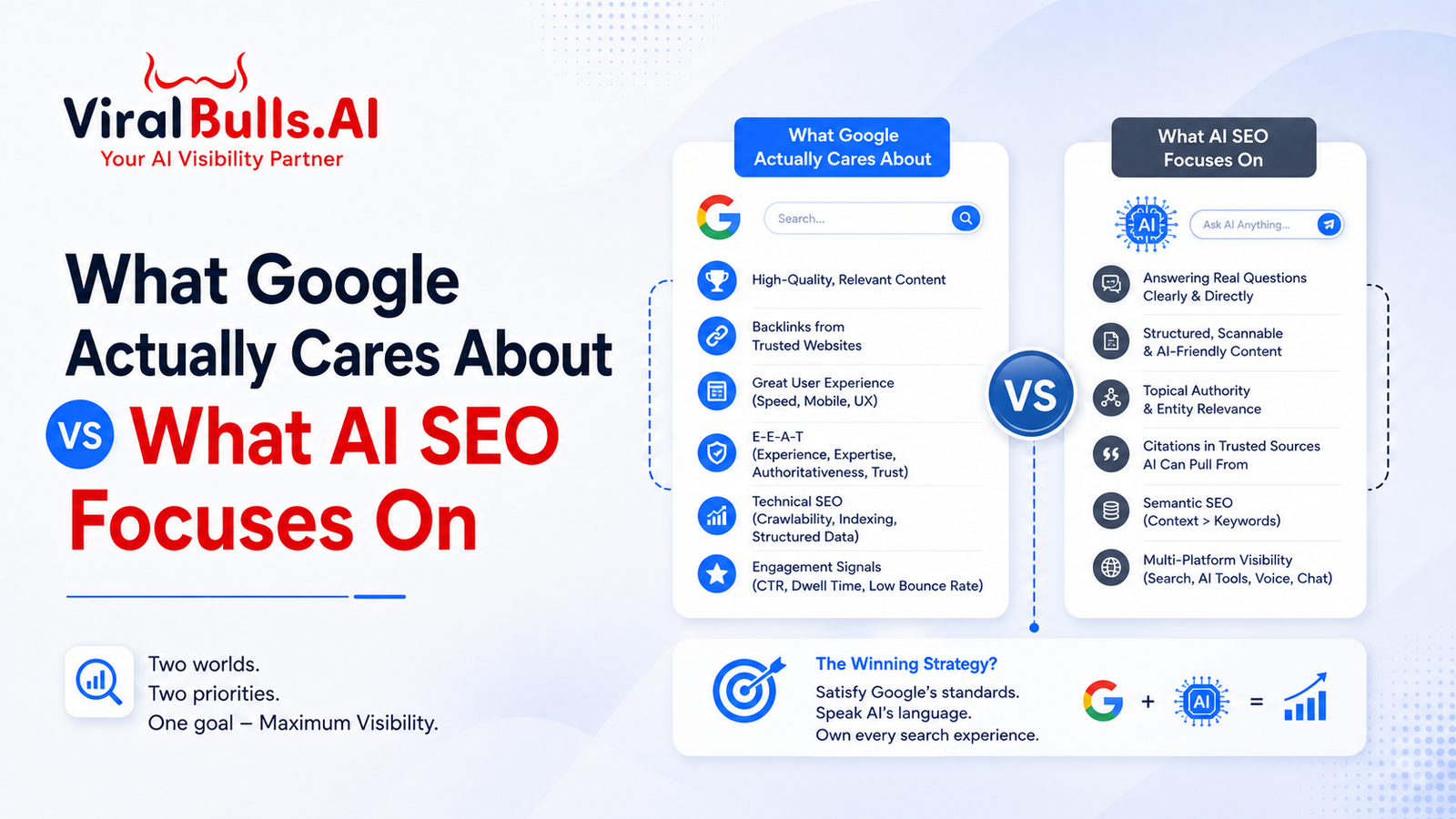
At first, these may sound like two completely different optimization problems. Google SEO appears to revolve around rankings, crawling, backlinks, technical performance, and helpful content, while AI SEO seems to focus on conversational answers, semantic understanding, citations, entities, and machine-readable information.
But the reality is more nuanced.
Google’s current guidance makes it clear that its ranking systems are designed to prioritize helpful, reliable, people-first content, while its generative AI experiences remain rooted in the same core Search ranking and quality systems. In other words, AI visibility does not eliminate SEO fundamentals. It builds on them.
So, what does Google actually care about, what does AI SEO focus on, and where do the two overlap?
Let’s break it down.
What Does Google Actually Care About?
Google does not provide marketers with a simple checklist where completing ten tasks guarantees position one.
Its Search systems use multiple signals and systems to determine which pages are relevant and useful for a particular query. Google’s own documentation repeatedly emphasizes helpfulness, quality, reliability, originality, usability, and satisfying the needs of the searcher.
1. Helpful, People-First Content
Google does not want content created merely because a keyword has search volume.
Its guidance encourages businesses to create information primarily for their real audience rather than publishing pages whose main purpose is attracting search traffic. Google recommends asking whether content helps someone achieve their goal and whether it provides meaningful value compared with competing pages.
That means a page should do more than mention the right keywords.
It should actually solve the searcher’s problem.
For example, suppose someone searches:
“How much does AI marketing cost for a small business?”
A weak SEO article might repeat phrases such as “AI marketing cost” throughout the page.
A stronger article could explain:
- Typical cost components
- Factors affecting pricing
- Different service models
- Technology costs
- Agency costs
- Potential ROI considerations
- Questions businesses should ask before investing
The second page provides greater decision-making value.
That is much closer to what Google wants to reward.
2. Originality and Added Value
Simply rewriting the same information available across the internet is becoming increasingly difficult to justify as an SEO strategy.
Google specifically encourages original information, research, analysis, comprehensive explanations, and content that provides value beyond simply summarizing existing sources.
This becomes especially important in an era when AI can produce generic informational content almost instantly.
Original value could include:
- First-hand experience
- Internal data
- Real case studies
- Expert commentary
- Original frameworks
- Industry observations
- Customer insights
- Practical examples
AI can help structure a page, but businesses still need something worth discovering.
3. Experience, Expertise and Trust
Google’s content guidance discusses signals associated with experience, expertise, authoritativeness, and trustworthiness, commonly referred to as E-E-A-T. It encourages clear sourcing, evidence of expertise, author information where appropriate, and content that avoids easily verifiable factual errors.
Imagine two articles about enterprise AI implementation.
One gives broad definitions that could have been written by anyone.
The other includes:
- Implementation challenges
- Real project considerations
- Infrastructure decisions
- Security concerns
- Deployment examples
- Lessons from actual AI projects
The second communicates deeper subject understanding.
Google increasingly has more reason to see it as useful.
4. Technical Accessibility
Great content cannot perform effectively if Google cannot properly access or understand it.
Pages still need to satisfy fundamental Search requirements.
Important areas include:
- Crawlability
- Indexability
- Internal linking
- Logical website structure
- Accessible text content
- Appropriate technical directives
- Accurate structured data
For Google’s AI features specifically, a supporting page must already be indexed and eligible to appear in Google Search with a snippet. Google says there are no additional technical requirements specifically for appearing in AI Overviews or AI Mode.
This is an important point.
AI visibility does not allow businesses to skip technical SEO.
5. Good Page Experience
Google also recommends providing a strong overall page experience rather than obsessing over one individual technical metric.
Useful content should also be easy to consume.
That can involve:
- Mobile-friendly presentation
- Fast loading
- Clear navigation
- Secure browsing
- Stable layouts
- Readable typography
- Avoiding disruptive elements
Google states that its core ranking systems consider various signals aligned with good page experience, although there is no single “page experience” ranking signal that determines success by itself.
6. Avoiding Manipulation
Google also cares about what businesses do not do.
Its spam systems attempt to detect tactics designed primarily to manipulate rankings. Google explicitly warns that using automation, including generative AI, to create large quantities of pages without adding user value may violate its scaled content abuse policies.
So using AI is not automatically the problem.
Using AI to manufacture low-value search pages at scale can be.
What Does AI SEO Focus On?
AI SEO expands the optimization mindset beyond simply asking:
“Can this page rank?”
It also asks:
“Can an AI system understand this information, retrieve it, connect it to the right topic, and confidently use it when answering a question?”
In practice, AI SEO often focuses on several additional dimensions.
1. Conversational Search Intent
Traditional keyword research might target:
“best AI marketing agency”
AI-driven search journeys can become far more specific:
“Which type of AI marketing agency should a B2B SaaS company use if it wants better visibility in both Google and AI search?”
AI SEO therefore places greater emphasis on understanding complete questions, contexts, comparisons, follow-up queries, and user intent.
Google itself says its AI Mode can support nuanced questions, exploration, reasoning, and complex comparisons that previously might have required several individual searches.
2. Semantic and Topical Understanding
AI SEO is generally less concerned with repeating one exact-match keyword twenty times.
It focuses more heavily on whether a page thoroughly explains a subject.
For example, a strong page about AI SEO might naturally discuss:
- AI search
- Search intent
- Generative search
- AI Overviews
- AI visibility
- Traditional SEO
- Content authority
- Entity recognition
- Search experience
- Structured information
The objective is to establish meaningful topical context rather than manufacture keyword density.
Google also notes that its systems can understand synonyms and general meaning, and specifically says businesses do not need to rewrite content purely to capture every possible query variation for generative Search.
3. Clear, Answerable Information
AI-oriented optimization frequently encourages content that makes important information easy to identify.
For example:
What is AI SEO?
AI SEO is the use of artificial intelligence in search optimization and the optimization of digital content for AI-powered search and discovery experiences.
That kind of direct explanation can work well for readers because it immediately answers the question.
But this does not mean every article needs to be broken into tiny artificial “AI-friendly chunks.”
Google explicitly says there is no special chunking requirement for its generative Search systems and recommends choosing content length and structure based on what serves the audience.
4. Entity and Brand Clarity
AI SEO also places more attention on whether digital systems can clearly understand:
- Who your company is
- What you offer
- Which market you serve
- What subjects you specialize in
- Which products or services belong to you
- How your brand relates to relevant industry topics
For businesses, this means inconsistent or vague positioning can become a visibility problem.
Your website, service pages, company profiles, thought leadership, third-party references, and supporting content should tell a coherent story about the brand.
The goal is not merely to associate a website with keywords.
It is to establish a clear digital identity.
5. Citation and Recommendation Potential
Traditional SEO often asks:
“Can we get this URL into the top ten?”
AI SEO may additionally ask:
“Is this information strong enough to support an AI-generated answer?”
Google’s generative AI experiences can retrieve relevant pages from the Search index and use them to support generated responses with links. Google says these systems remain connected to its core ranking and quality infrastructure.
That means content designed to earn AI visibility should still focus on qualities such as:
- Accuracy
- Originality
- Clear expertise
- Useful explanations
- Relevant evidence
- Strong topical depth
Google SEO vs AI SEO: Key Differences
| Area | What Google SEO Emphasizes | What AI SEO Often Emphasizes |
|---|---|---|
| Primary Goal | Organic search visibility | Visibility across AI-driven discovery |
| Content | Helpful, reliable, people-first | Clear, authoritative, answer-ready content |
| Queries | Search intent and relevance | Conversational and multi-step intent |
| Keywords | Relevant search terminology | Topics, meaning, entities and context |
| Technical SEO | Crawlability and indexability | Machine accessibility still remains essential |
| Authority | Quality, trust and useful signals | Credibility and reference-worthiness |
| Structure | User-friendly organization | Clear information relationships |
| Success Metrics | Rankings, clicks, traffic, conversions | AI appearances, references, visibility and conversions |
| Strategy | Search engine optimization | Search plus AI discovery optimization |
The important point is that these columns are not opposites.
They increasingly overlap.
The Biggest AI SEO Myth: Google Needs Completely Different Optimization
One of the easiest mistakes businesses can make is believing that Google AI search requires an entirely new technical playbook.
Google currently says otherwise.
For AI Overviews and AI Mode, Google states that traditional SEO best practices remain relevant and that no special schema, separate AI markup, or new machine-readable file is required.
Google has even specifically addressed several popular AI-search ideas.
For its own Search ecosystem, Google says businesses do not need to:
- Create special AI markup
- Create llms.txt files for Google Search
- Rewrite pages purely for AI
- Artificially divide every page into tiny content chunks
- Chase inauthentic brand mentions
Its recommendation remains surprisingly familiar: build technically accessible websites and publish unique, reliable, genuinely useful content.
So, Should You Optimize for Google or AI?
The better strategy is to stop treating them as separate marketing channels.
A modern search strategy should begin with Google fundamentals and expand into AI visibility.
Start With Strong SEO Foundations
Make sure your website can be:
- Crawled
- Indexed
- Understood
- Navigated easily
- Trusted
- Used comfortably
Without these fundamentals, AI optimization becomes much harder.
Create Content Humans Actually Need
Do not start with:
“How many keywords can we fit into this page?”
Start with:
“What does the customer genuinely need to understand?”
Then build the page around that need.
Add Something AI Cannot Easily Reproduce
Generic definitions are becoming commodities.
Stronger content includes:
- Original research
- Real examples
- Case studies
- Expert insights
- Unique processes
- First-hand knowledge
- Proprietary data
That creates value for both traditional search and AI-driven discovery.
Think in Topics, Not Individual Keywords
Build content ecosystems instead of publishing disconnected blog posts.
A business targeting AI marketing could develop authoritative content around AI SEO, AI search visibility, AI content strategy, automation, analytics, generative search, and AI-driven customer acquisition.
Each page supports the wider subject.
Measure More Than Rankings
Keyword positions still matter.
But modern search teams should also pay attention to:
- Organic traffic
- Qualified visits
- Conversions
- Brand searches
- Topic visibility
- AI-driven discovery
- Search impressions
- Content engagement
Google also recommends using Search Console as the first-party source for understanding Search performance and cautions that third-party SEO and AI optimization tools do not have access to Google’s internal ranking systems.
Google and AI SEO Are Moving Toward the Same Core Principle
Google wants to connect searchers with useful information.
AI-powered search wants to understand questions and produce useful answers.
Those goals are much closer than they initially appear.
Google SEO focuses heavily on relevance, quality, accessibility, trust, originality, and user satisfaction.
AI SEO extends the strategy toward semantic understanding, conversational intent, entity clarity, answer visibility, and AI-driven discovery.
Businesses therefore should not abandon SEO fundamentals in pursuit of the latest AI optimization tactic.
The stronger approach is:
Build for people. Make it understandable to machines. Establish genuine authority. Then optimize distribution across both traditional and AI-powered search.
For brands navigating this transition, Viralbulls AI approaches search visibility beyond traditional rankings by combining established SEO principles with AI-focused visibility strategies.
Because the future of search is not simply about being ranked.
It is about becoming the brand that search engines find, understand, trust, surface, and recommend.