
A product launch is approaching. The packaging is approved. The campaign plan is ready. But the video is still waiting on a studio, equipment, talent, props, lighting, editing, and approvals.
Traditional product shoots can create beautiful, highly controlled visuals. They can also become slow when a brand needs ten versions instead of one, several languages instead of one, or new creative every week.
AI product videos introduce a different production model. Brands can generate product demonstrations, lifestyle scenes, feature explainers, and platform-specific variations without rebuilding the entire shoot every time.
The real question is not whether AI can replace a camera. It is whether the campaign needs physical realism, creative scale, speed, or a combination of all three.
Why Product Video Is Now a Continuous Requirement
Product video is no longer reserved for major campaigns. Ecommerce pages, paid social ads, marketplaces, landing pages, email campaigns, and product launches all need moving visuals.
A single hero film is rarely enough. Teams need short hooks, vertical edits, product close-ups, comparison scenes, and localized content.
This creates a production problem. Traditional shoots are built around a planned shot list. Performance marketing demands an ongoing stream of creative variations.
- Paid social needs frequent creative refreshes.
- Ecommerce pages need product demonstrations.
- Marketplaces require specific video formats.
- Different audiences respond to different benefits.
What Are AI Product Videos?
AI product videos are created or enhanced using generative visuals, synthetic environments, automated motion, AI voice, virtual presenters, or intelligent editing.
They can turn approved product images, renders, scripts, and brand guidelines into multiple concepts. A product may appear in a generated lifestyle scene, rotate in a studio-style environment, demonstrate a feature, or be introduced by a digital presenter.
Professional AI product video services involve more than prompting. The process includes concept development, asset preparation, brand controls, product accuracy checks, editing, sound, captions, and final review.
What Traditional Product Shoots Still Do Best
Traditional shoots capture the real object under controlled conditions. This matters when texture, material quality, fit, scale, movement, food appearance, or physical interaction must be shown accurately.
A skilled team can control lighting, motion, styling, props, models, and practical effects. Real footage is also easier to trust when precise product demonstration matters.
Traditional production remains strong for premium brand films, fashion fit, food and beauty textures, complex machinery, and campaigns where tactile realism is part of the selling point.
Where AI Product Videos Have the Advantage
AI becomes useful when the marketing requirement is larger than the original shoot plan.
A brand may need the same product shown in different rooms, seasons, cities, languages, or audience contexts. It may also need several openings for paid advertising before selecting the strongest direction.
AI product videos can create those variations faster than repeated productions. They are useful for concept testing, launch teasers, digital products, localized campaigns, and ongoing social content.
1. Cost: One Shoot vs an Ongoing Content System
Traditional production includes crew, studio, equipment, talent, styling, props, travel, editing, and possible reshoots. These costs may be justified when the footage supports a major campaign or must show exact physical detail.
AI production shifts the cost structure toward strategy, source assets, generation, editing, and quality control. Additional variations may then cost less than another complete shoot.
AI is not automatically cheap. Complex products, weak reference images, and repeated corrections can increase production time. The correct comparison is the cost per usable asset, not the price of one clip.
2. Speed: From Scheduling to Iteration
Traditional shoots require coordination before filming starts. Availability, locations, samples, props, and approvals can affect the timeline.
AI workflows can move faster once the concept and product assets are ready. A team can revise a headline, replace a background, test a different opening, or create a shorter edit without returning to the studio.
This speed is valuable in performance marketing, where offers change and creative fatigue demands regular updates.
3. Scalability: One Master Film vs Many Useful Variations
A traditional shoot can produce many assets when the shot list is planned well. But each additional scene, model, location, or language adds complexity.
AI product video services can adapt one approved direction into multiple formats, markets, and audience messages. The product can appear in a premium setting for one segment and a practical setting for another.
The value comes from matching each message to its audience instead of forcing one video to perform every job.
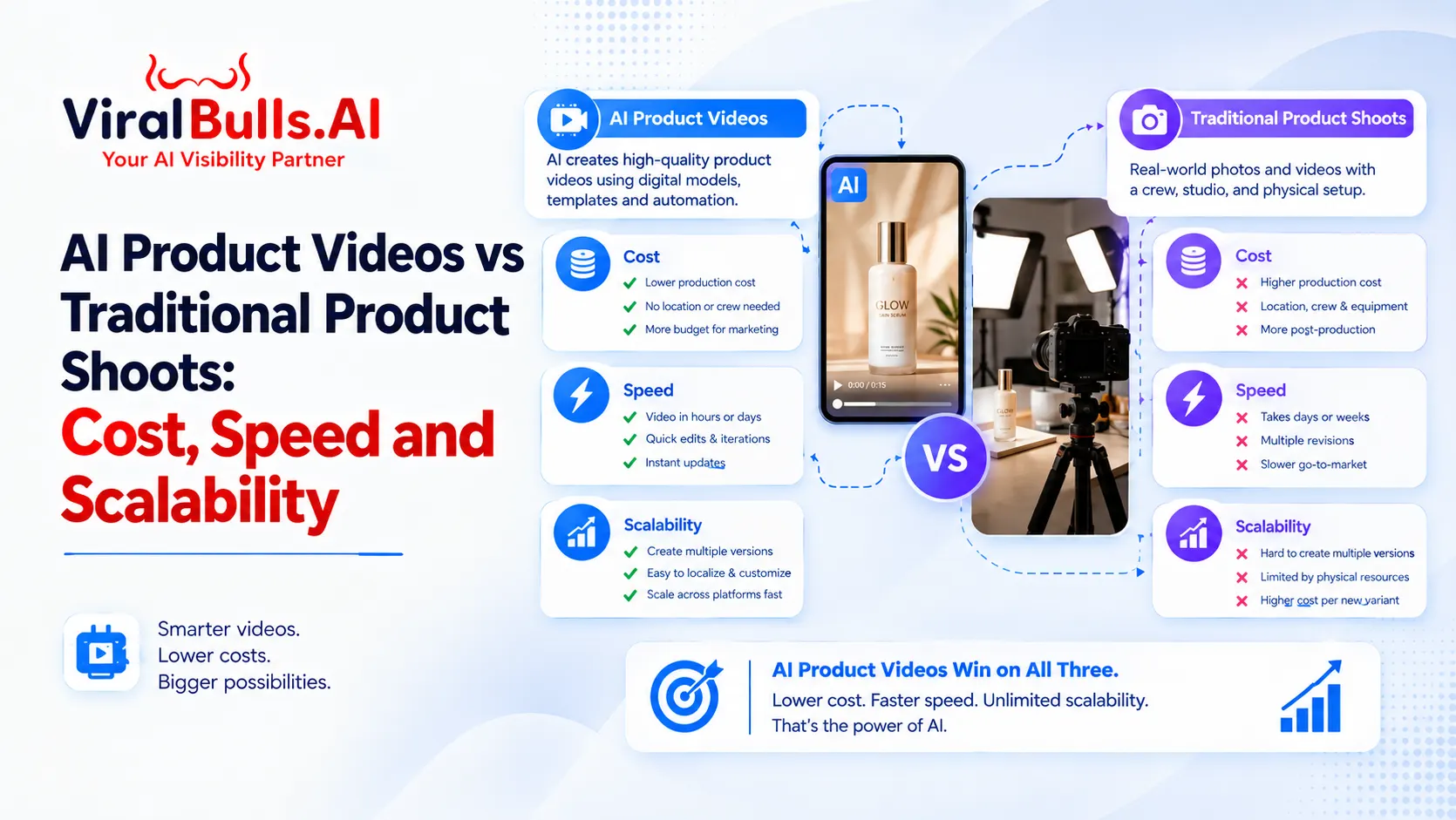
AI Product Videos vs Traditional Product Shoots
| Factor | AI Product Videos | Traditional Product Shoots |
| Production cost | Lower marginal cost for variations | Higher upfront production cost |
| Speed | Fast revisions and new versions | Requires setup and possible reshoots |
| Scalability | Strong for formats, markets, and audiences | Limited by captured footage |
| Physical accuracy | Requires strict review | Captures the real product |
| Creative flexibility | Easy to explore environments | Strong real-world art direction |
| Best use | Testing, localization, ongoing content | Hero films and real demonstrations |
When Brands Should Choose AI Product Videos
AI is a strong option when the brand needs fast testing, frequent content, multiple formats, visual concept exploration, or localization.
It is also useful when the product is digital, the physical item is not yet available, or the campaign needs an environment that would be expensive to build.
- Rapid A/B testing
- Multiple platform formats
- Seasonal and offer-led variations
- Multilingual campaigns
- Digital products and software
- Pre-launch concepts
When a Traditional Shoot Is the Better Investment
A real shoot is usually better when the product must be worn, handled, assembled, tasted, tested, or shown with precise physical accuracy.
It is also stronger when the brand wants a distinctive visual identity built through art direction, performance, location, and cinematography.
Products with reflective packaging, transparent materials, detailed textures, or moving parts may require real footage to avoid visual errors.
The Hybrid Model: Capture Reality Once, Scale It Intelligently
The most practical strategy is often hybrid production.
A brand can use a traditional shoot to capture accurate hero footage, product angles, textures, and demonstrations. AI can then extend those assets into new formats, backgrounds, hooks, voiceovers, and localized versions.
This protects product accuracy while reducing repeated shoots. AI can also support pre-production by helping teams test concepts and storyboards before committing to sets and locations.
What Can Go Wrong with AI Product Video Production?
AI can create incorrect labels, distorted packaging, impossible reflections, inconsistent proportions, unnatural hands, or scenes that do not match the brand.
These errors are risky when the generated video changes a product feature or creates an expectation the real item cannot meet.
Every output needs human review against approved references. Brands should not use generated demonstrations as proof unless the visual accurately represents a real and supportable capability.
- Incorrect logos or label text
- Changed product shape or color
- Unrealistic demonstrations
- Inconsistent packaging between scenes
- Generic or artificial visual quality
How ViralBulls Builds Scalable Product Video Systems
ViralBulls approaches product video as a content system rather than a one-time deliverable.
We identify where the video will be used, which audience it must influence, what details must remain exact, and how many variations the campaign needs.
Our AI product video services can include concept development, scripting, source asset preparation, AI scene generation, product animation, voice integration, editing, captions, localization, and platform-specific versions.
Where real footage is necessary, we recommend a traditional or hybrid plan. The objective is to choose the method that creates the strongest balance of quality, speed, and usable output.
Final Verdict: Match the Production Model to the Campaign
Choose AI product videos when the campaign needs speed, multiple variations, localization, digital environments, or continuous creative testing.
Choose traditional product shoots when physical accuracy, tactile detail, real interaction, premium cinematography, or complex demonstrations are essential.
Choose a hybrid model when the brand needs both real product credibility and scalable content production.
Use methods where they create value.
Frequently Asked Questions
They are created or enhanced using generative visuals, AI motion, virtual environments, automated editing, synthetic voice, or digital presenters. Brands use them for advertising, ecommerce, launches, and social media.
They can reduce the cost of repeated variations, localization, and reshoots. Final cost depends on product complexity, source assets, quality requirements, and the number of deliverables.
It can when the workflow uses strong reference assets and careful review. Complex shapes, reflective materials, labels, and detailed demonstrations may still require real footage.
Yes. A hybrid workflow can use real footage for accuracy and AI for backgrounds, edits, formats, localization, and campaign variations.
They may include strategy, scripting, concept development, asset preparation, generation, animation, editing, voiceover, localization, captions, and platform-specific versions.