
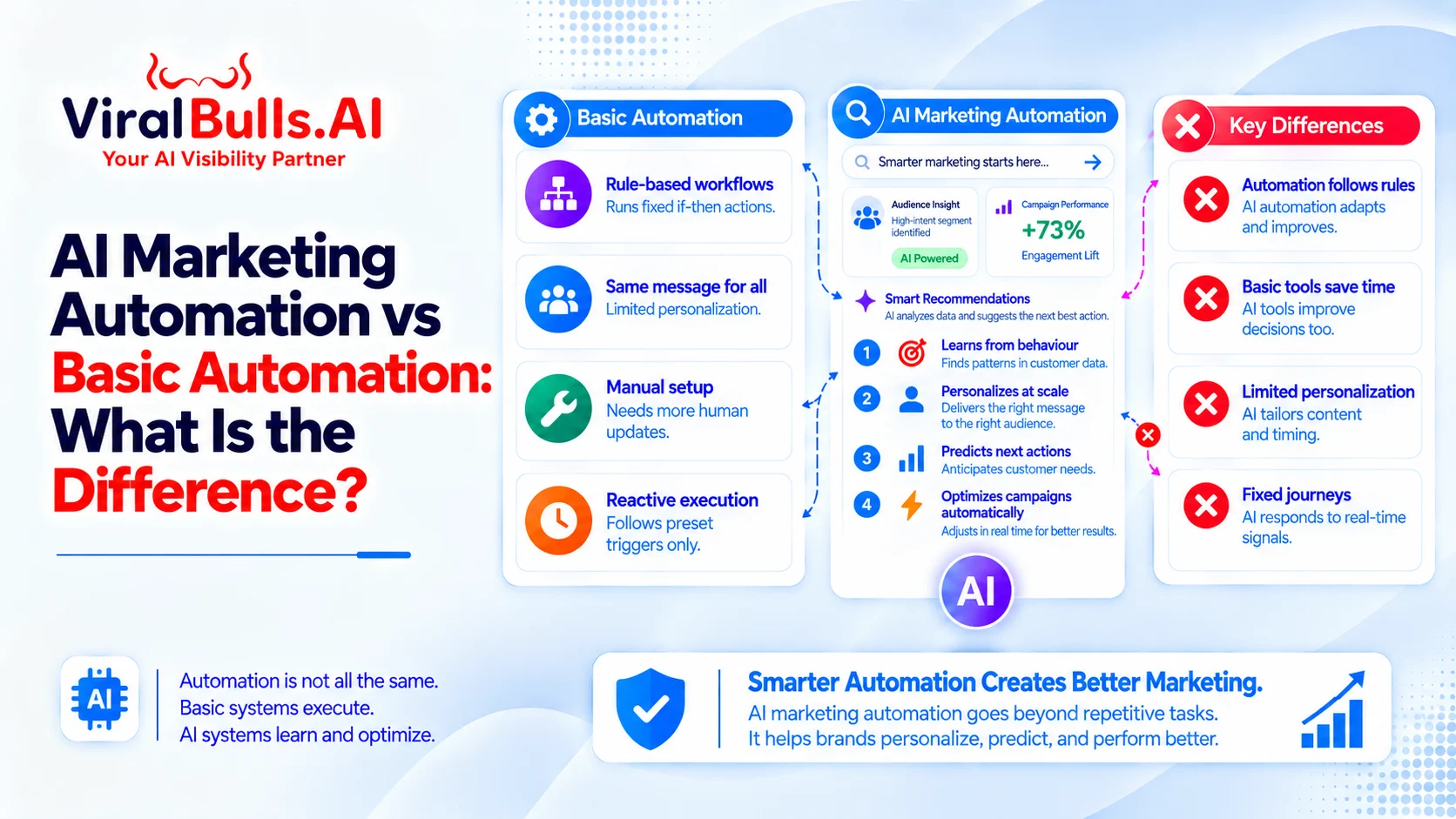
A lead downloads an ebook. Basic automation sends an email three minutes later.
That is useful. But what if the lead has already visited the pricing page, works in a target industry, engaged with three ads, and previously ignored two introductory emails?
Sending the same message to everyone is automated, but it is not intelligent.
AI marketing automation uses data and models to help systems predict, classify, personalize, prioritize, or generate actions. The difference is not that one uses software and the other does not. The difference is how much judgment the system can apply.
What Is Basic Marketing Automation?
Basic automation follows predefined conditions.
If a person submits a form, add them to a list. If they abandon a cart, send a reminder. If a deal reaches a certain stage, notify sales. If an email is unopened, resend it with a different subject line.
These workflows are deterministic. Marketers decide the triggers, branches, delays, and outputs in advance.
Basic automation is reliable, explainable, and often exactly what a business needs. It becomes limiting when the number of customer paths grows beyond what a team can reasonably map and maintain.
What Is AI Marketing Automation?
AI marketing automation adds prediction, classification, generation, or continuous optimization to automated workflows.
Instead of using only fixed rules, the system may estimate purchase intent, recommend the next best message, select a creative variation, summarize account activity, score leads, or identify audiences likely to respond.
AI automation services connect these capabilities to real marketing operations. That may involve data preparation, platform integration, model or tool selection, workflow design, testing, human approvals, and performance monitoring.
The Main Difference: Rules vs Probability
Basic automation asks, “Did the predefined event happen?”
AI-enabled automation can ask, “Based on the available signals, what is most likely to happen, and what action should we take?”
The answer is probabilistic, not guaranteed. That is why AI systems require thresholds, review rules, monitoring, and fallback paths.
AI should not be given unrestricted control simply because it can produce an answer. The level of autonomy should match the risk of the decision.
Where Basic Automation Works Best
- Form confirmations and internal notifications
- Simple lead routing based on geography or service
- Appointment reminders
- Cart and browse abandonment sequences
- Invoice, renewal, and subscription notices
- Fixed onboarding steps
- Compliance-driven communications with approved wording
These workflows have clear conditions and repeatable outcomes. Adding AI may increase cost or uncertainty without improving the result.
Where AI Creates Additional Value
- Predictive lead scoring using multiple behavioral and firmographic signals
- Message recommendations based on stage, interest, and previous response
- Dynamic audience segmentation
- Creative and offer variation at scale
- Conversation summaries and sales preparation
- Churn or disengagement prediction
- Budget and campaign insights drawn from complex performance data
AI is most useful when the marketing team has too much information for fixed rules to process effectively.
Personalization: Token Replacement vs Real Context
Basic personalization inserts a name, company, product, or location into a standard message.
AI-supported personalization can use broader context. It may summarize what an account researched, identify the most relevant service, or adapt an explanation to the customer’s stage.
That does not mean every customer should receive completely generated communication. Brands need approved claims, tone guidelines, privacy controls, and rules for when a human should review the message.
Data Quality Determines Automation Quality
AI cannot repair a broken marketing foundation by itself.
If CRM stages are inconsistent, campaign tracking is missing, customer records are duplicated, and consent data is unreliable, the system will learn from or act on poor information.
Before implementing AI marketing automation, businesses should standardize key fields, define lifecycle stages, connect data sources, document permissions, and decide which metric represents success.
The first project should be narrow enough to evaluate. Automating every channel at once makes it difficult to identify what created the result.
The Risks Businesses Need to Control
AI can generate inaccurate statements, over-personalize in ways that feel intrusive, misclassify valuable leads, or optimize toward a metric that does not reflect revenue.
Controls should include human approval for sensitive content, protected customer data, role-based access, model and workflow logs, performance reviews, and clear escalation paths.
Marketing teams should also maintain a non-AI fallback. If the model or integration fails, critical customer communication should continue safely.
A Practical Implementation Roadmap
- Map current marketing workflows and identify repetitive decisions.
- Separate simple rule-based tasks from decisions that require interpretation.
- Choose one measurable AI use case, such as lead prioritization or content variation.
- Clean the minimum data required for that use case.
- Build approvals, thresholds, and fallback rules before launch.
- Compare the AI-assisted process against the previous baseline.
- Expand only after accuracy, efficiency, and business value are demonstrated.
How ViralBulls Builds AI Automation Systems
ViralBulls designs automation around the customer journey and the marketing team’s real operating process.
We use basic automation where fixed rules are sufficient and AI where prediction, context, or content scale creates additional value. Our AI automation services can include workflow mapping, CRM and platform integration, data preparation, prompt and model controls, reporting, and ongoing optimization.
The objective is not to remove marketers. It is to reduce repetitive execution and give the team better information for decisions.
Final Thought: Intelligent Does Not Mean Complicated
The best automation is the simplest system that reliably improves the customer experience and business outcome.
Basic automation remains essential. AI marketing automation extends it when fixed rules cannot handle the volume or complexity of available data.
Businesses should not ask whether every workflow can use AI. They should ask where better judgment, faster analysis, or scalable personalization would make a measurable difference.
AI Marketing Automation vs Basic Automation
| Area | Basic Automation | AI Marketing Automation |
|---|---|---|
| Logic | Predefined if-then rules | Predictions, classifications, or generated actions |
| Personalization | Fixed fields and segments | Contextual and adaptive recommendations |
| Maintenance | Rules must be manually updated | Models and workflows require monitoring |
| Explainability | Usually straightforward | May require additional interpretation |
| Best use | Stable, repeatable processes | Complex decisions and high-volume data |
| Risk | Broken rules or integrations | Inaccuracy, bias, privacy, and over-automation |
How to Choose the Right Level of Automation
Use a simple rule when the business decision is stable, transparent, and low-risk. A confirmation email does not need prediction. A reminder does not need a language model. Adding AI to these tasks may make the workflow harder to audit without improving the customer experience.
Use AI when the system must interpret several signals, summarize complex information, recommend an action, or generate controlled variations. Even then, begin with decision support rather than full autonomy. Let the system recommend which leads deserve attention before allowing it to change pipeline stages automatically.
The correct level of automation also depends on team maturity. A business that does not maintain its CRM or campaign tracking should first fix those operating habits. AI scales the process it receives. It cannot create disciplined marketing operations from inconsistent inputs.
Cost should be assessed across the full operating cycle. AI may reduce manual work, but it introduces platform fees, integration effort, monitoring, and governance. A simple workflow that runs reliably for years can deliver more value than an advanced system that constantly needs correction.
Ownership must be clear after launch. Marketing should define the customer logic, operations should maintain the process, technology teams should protect integrations and data, and leadership should approve the risk boundaries. Automation fails when everyone uses it but no one is accountable for it.
Frequently Asked Questions
No. It remains the best choice for many clear and repeatable workflows. AI should be added only when it creates measurable value.
It combines marketing workflows with AI capabilities such as prediction, segmentation, generation, recommendation, or optimization.
Not always. Some applications use existing models and limited business data. Predictive use cases generally improve when the relevant data is consistent and sufficient.
It can, but businesses should use approved templates, claim controls, review rules, and human oversight based on the risk of the communication.
Start with a repetitive, measurable process that currently consumes time or causes slow response, such as lead routing, summaries, or content variations.
They may include strategy, workflow mapping, data integration, platform setup, governance, testing, reporting, and optimization.